Inku vs Duolingo for Japanese
Duolingo is a game-like course for many languages. Inku is a Japanese-only app for learning and reviewing kana, kanji, vocabulary and phrases.
How does Inku compare to Duolingo?
Inku publishes this comparison. Duolingo is often the first app a Japanese learner tries: it teaches more than 40 languages through short lessons, and its App Store listing describes game-like lessons for speaking, reading, listening and writing. Inku does one language and one kind of study. It teaches Japanese words, phrases and characters in short lessons and then brings each item back for review when it is due. The tools overlap less than they seem, because one is a course and the other is a study routine.
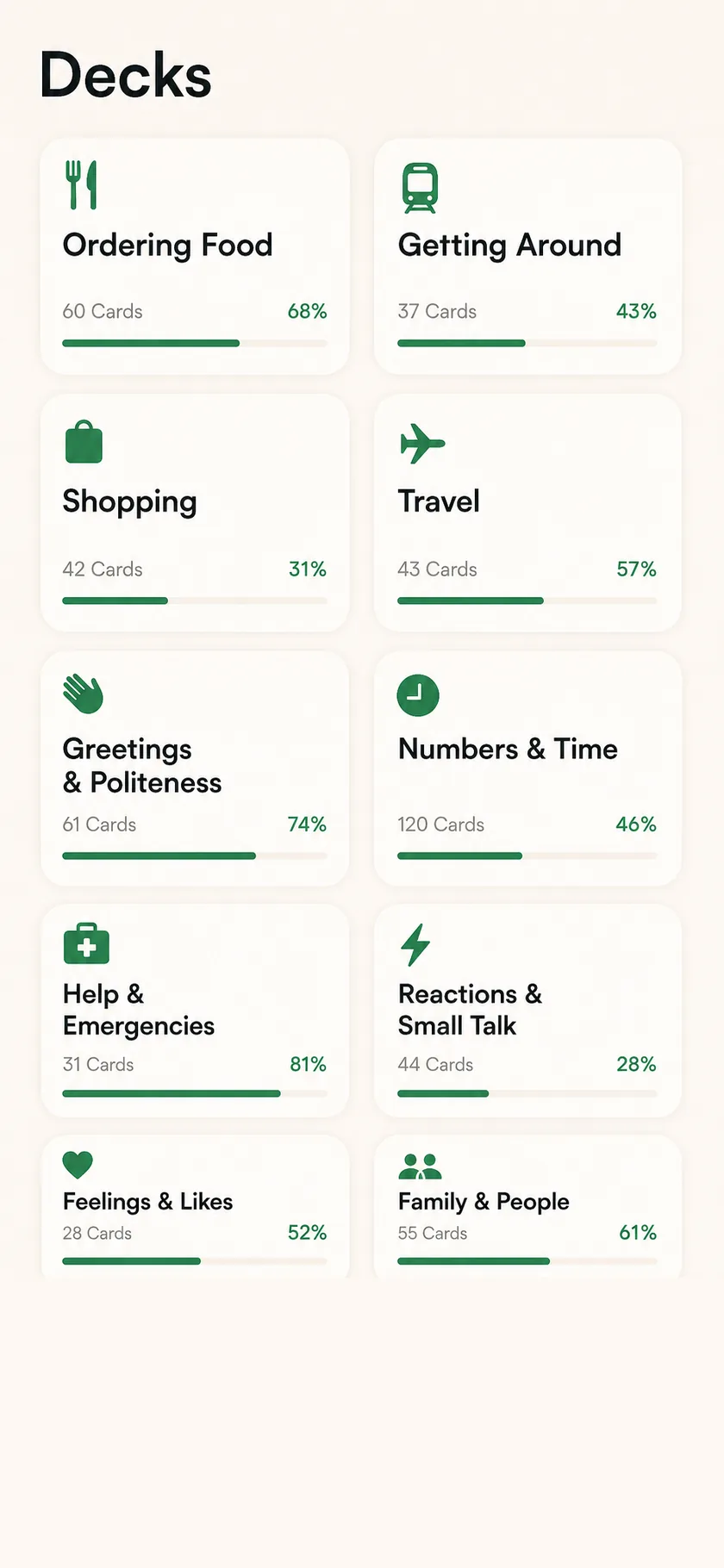
Food, travel, and more.
Start with kana, then build vocabulary from N5 to N1 and phrases for everyday situations. The iPhone app has 2,568 vocabulary cards, 960 kanji and 407 phrases, verified 2026-10-16.
When is Inku the better choice?
- You want to choose what you study. Inku lets you open a JLPT level, an everyday topic such as food or travel, a phrase pack, kana or kanji, and study that directly. Duolingo moves you along its own course path.
- You want vocabulary to come back when you are about to forget it. Inku schedules every word, phrase, kana and kanji with FSRS, based on your own answers. Duolingo includes practice, but its course is organized around lessons rather than an item-by-item review queue.
- You find leagues and hearts distracting. Inku has no leagues, hearts or leaderboards. The web app shows a daily streak, XP and earned stamps, and a session ends when its cards are done.
- You want to work toward JLPT vocabulary. Inku has vocabulary decks for every JLPT level from N5 to N1, plus a kanji course. They are curated study decks, because the JLPT does not publish official word lists.
When is Duolingo the better choice?
- You want to start without paying. Duolingo's Japanese course can be used at no cost with ads, and Duolingo Super removes them. Studying in Inku needs an Inku Pro subscription.
- You want several languages in one app. Duolingo teaches more than 40 languages. Inku teaches only Japanese.
- You want a full beginner course with sentences. Duolingo teaches through sentence exercises that cover reading, listening, speaking and writing. Inku teaches words, phrases and characters, and it does not have grammar lessons.
- You are motivated by competition. Duolingo has leagues and other game features. Inku has no social or competitive features.
Inku and Duolingo side by side
| Criterion | Inku | Duolingo |
|---|---|---|
| Format | Lessons of five items, then spaced review | A course path of short exercises |
| Languages | Japanese only | More than 40 |
| Choosing material | Pick a level, topic, phrase pack, kana or kanji | Follow the course order |
| Review scheduling | FSRS for each item | Practice inside the course |
| Grammar | Not taught | Taught through sentence exercises |
| Motivation features | Streak, XP and stamps; no leagues | Leagues, streaks and other game features |
| Ads | None | On the free tier |
| Cost | Inku Pro subscription | Free with ads, or Duolingo Super |
| Platforms | iPhone app and web app | iPhone, Android and web |
Sources and pricing
Pricing last checked: October 16, 2026. Prices can vary by country, platform, checkout, tax, and promotion.
Our take
Duolingo is a good way to find out whether you enjoy Japanese, and its game features keep many people coming back. If you want to decide what to study and see each word return on a schedule, Inku is the more direct tool.
Verdict
Choose Duolingo for a no-cost, game-like course across many languages. Choose Inku for a focused Japanese vocabulary, phrase, kana and kanji routine with spaced review.
If you already use Duolingo, you can keep its course for sentences and use Inku to review the vocabulary you meet. Give each app a different job so you do not study the same words twice.
How we research this
Inku publishes this comparison, so it is not neutral. We check competitor claims against their official websites, help pages and App Store listings (last checked October 16, 2026), and Inku claims against the current iPhone listing and web app. Inku's pronunciation audio is synthesized speech, not human recordings. Found an error? Email app@inkujapanese.com and we will correct it.
Common questions
Can I use Inku and Duolingo at the same time?+
Yes. Duolingo can be your lesson path and Inku your vocabulary and kanji review. If both cover the same beginner words, you will review them twice, so give each app a different job.
Does Inku have a streak?+
Yes. Inku shows a daily streak and your progress. On the web, one learn or one review keeps the streak going, and there are no leagues or hearts.
Do I need to pay for Inku?+
Yes. Studying in Inku needs an Inku Pro subscription. Duolingo has a free tier with ads.
Related comparisons
Looking at this as a switch rather than a head-to-head? See the best Duolingo alternative for Japanese.
Other Inku comparisons worth a look:
Or zoom out: the best Japanese flashcard apps roundup, all comparisons, and all alternatives. New to Japanese? Start with the full learning roadmap.